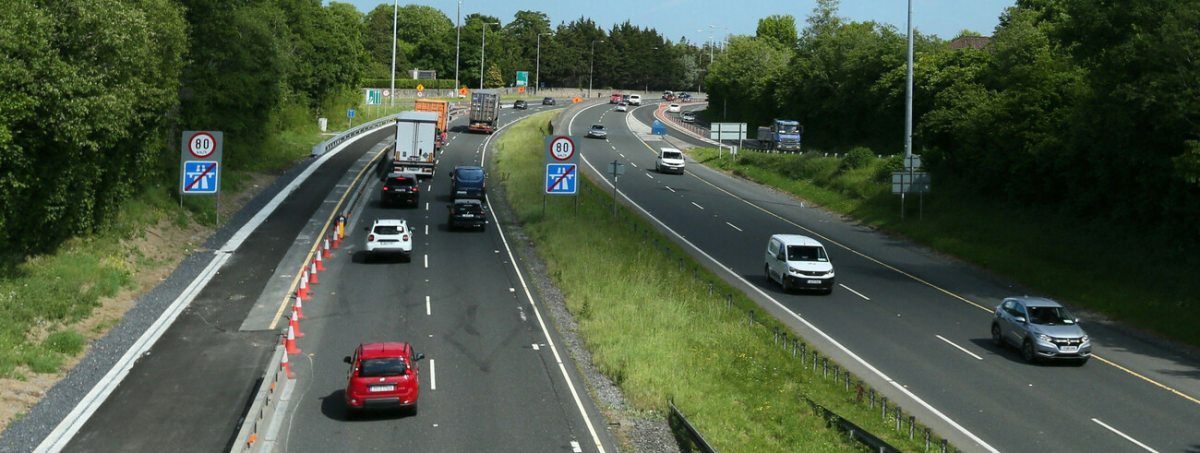
The Road Safety Authority (RSA) is considering whether motorway driving should become a more practical part of learner-driver training, putting driver competence and real-world experience at the centre of Ireland’s approach to safer motorway use.
The proposal emerged during an Oireachtas Committee on Transport hearing on motorway safety, where RSA Chief Operations Officer Brendan Walsh said he personally believes motorway driving “must be part” of future driver training. The Journal report on the committee hearing said the RSA is working with the Department of Transport on the curriculum and preparing recommendations for its future development.
Currently, learner drivers in Ireland cannot drive on motorways under their learner permits. The Road Safety Authority’s learner-driver guidance sets out the restrictions applying to learner drivers, including the prohibition on driving on motorways.
For Health & Safety professionals, the proposed change is significant because it treats practical competence as an important preventative control. Motorways involve higher speeds, different lane-management requirements, merging and exiting procedures and longer distances between junctions. Giving learners structured experience of these conditions could help build confidence and familiarity before they become fully licensed drivers.
Walsh told the committee that Germany requires learner drivers to complete four hours of guided motorway driving before taking their test. He said Ireland should examine a similar approach, with the RSA due to engage with Queensland University researchers whose work has examined the design of future driver-training curricula.
The discussion also highlighted how driver education could work alongside engineering and technology. Transport Infrastructure Ireland (TII) has installed wrong-way warning signage on motorway interchange off-slips and has trialled radar detection technology at 12 junctions on the N18 and M7. TII Director of Network Management Pat Maher said those trials produced some positive results, although the technology is not yet sufficiently mature for widespread deployment, according to RTÉ’s coverage of the committee hearing.
The wider approach is therefore not about relying on a single intervention. Training, clearer road design, warning systems and emerging connected-vehicle technology can each contribute to a safer road environment. TII is also exploring the potential for mobile-phone alerts and future vehicle-to-infrastructure communication as the technology becomes more widely available.
The focus on training is particularly relevant as Ireland continues to develop its driver-testing and learner-driver system. A stronger practical component could give new drivers greater familiarity with motorway conditions while complementing the work already being undertaken through road engineering, enforcement and technology.
For the sector, the proposal highlights the value of combining human competence with engineering and technology in road safety. For employers, fleet operators and other organisations whose people spend significant time on the road, stronger driver preparation could complement existing occupational road-risk programmes and safer driving policies.
Source: The Journal / Road Safety Authority / Transport Infrastructure Ireland










.png)