
Galway City Council has approved a major active travel investment designed to strengthen road safety and improve access for pedestrians, cyclists and public transport users along one of the city's eastern transport corridors.
The Monivea Road (East) Active Travel Scheme will upgrade 1.7km of the R339 between Ballybane Road and Old Ballybrit Road. The project will be funded equally by the National Transport Authority’s Active Travel Fund and the Department of Housing’s Urban and Regeneration Fund, with the investment estimated at €7m–€8m, according to Connacht Tribune.
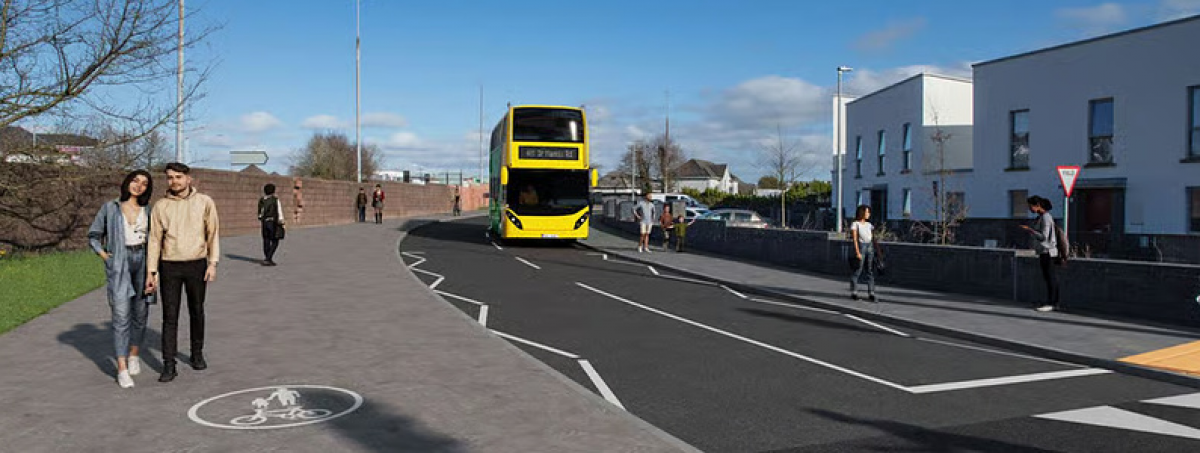
Approved by councillors on 18 November, the scheme will progress to detailed design. Its principal safety measures include a segregated two-way cycle track along the northern side of Monivea Road, upgraded footpaths on both sides, signalised crossings and redesigned side-road junctions. Raised crossings will also prioritise pedestrian and cyclist movements.
The infrastructure is intended to create clearer separation between road users, improve crossing points and make walking and cycling more practical for local journeys. Upgraded bus stops and shelters will support public transport users, while landscaping and connections to existing routes will strengthen the wider active travel network.
Galway City Council’s project announcement confirms that the route will connect with completed schemes on Ballybane and Castlepark Roads and link towards the future BusConnects Dublin Road development. It will also provide a connection to Parkmore through the existing Briarhill Junction underpass.
The approval follows debate among councillors about the design, access to properties and lessons from earlier active travel projects. In response, the council has committed to further engagement with residents and businesses and to appointing a Project Liaison Officer. The officer will act as a single point of contact throughout the project's lifetime, helping local stakeholders raise concerns and receive updates.
A continuous bus lane is not included because of space limitations along the route. The council's scheme information explains that accommodating one would require compulsory acquisition of property, including business land and parts of residents' gardens. Existing bus stops will instead be upgraded.
Construction dates have not yet been confirmed. Galway City Council says delivery will be coordinated with other major transport developments, including the N6 Galway City Ring Road and BusConnects Dublin Road scheme, to manage disruption and available resources.
For the sector, the lesson is direct: road safety improves when infrastructure is designed around the needs of all users. Galway’s investment demonstrates how public funding, considered engineering and stronger community engagement can work together to create safer journeys, support active travel and improve access to workplaces and local services.