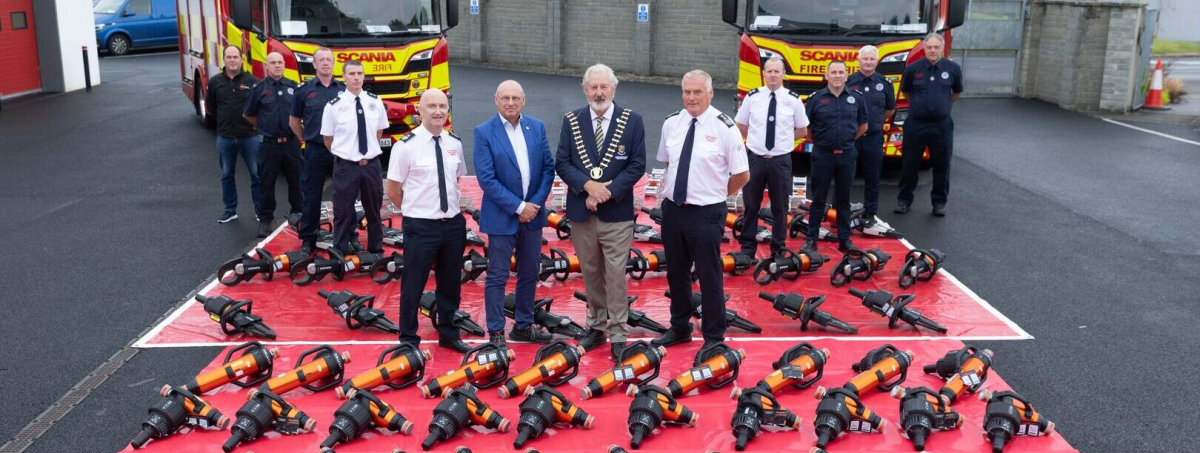
Clare County Fire and Rescue Service has taken delivery of ten sets of new battery-operated hydraulic rescue equipment following an investment of €512,792, strengthening safety and operational capability across the county’s seven fire brigades.
The new Holmatro rescue tools, funded by the Department of Housing, Local Government and Heritage, replace older petrol pump-driven equipment used by the service. Designed for road traffic collisions and other rescue incidents, the battery-powered systems provide improved performance, reliability and ease of use.
Clare County Fire and Rescue Service operates seven stations in Ennis, Shannon, Ennistymon, Scarriff, Killaloe, Kilrush and Kilkee, with 103 staff across firefighting, officer, administration and maintenance roles. The investment therefore provides a county-wide upgrade to equipment used in potentially high-risk rescue environments.
The Health & Safety benefits are particularly relevant at road traffic collision scenes. Moving away from petrol-driven pumps removes the need to operate a petrol engine alongside rescue work, reducing exhaust exposure and the handling and storage of fuel around an incident. Battery operation also significantly reduces equipment noise. Clare Chief Fire Officer Adrian Kelly said this can create a calmer environment for trapped casualties while making it easier for crews to communicate and provide reassurance during complex extrications.
The equipment is also intended to improve the safety and reliability of rescue operations themselves. Advanced diagnostic capabilities can support planned maintenance, servicing and asset management, helping identify equipment requirements before they affect operational readiness. Improved portability and ease of use can also support firefighters when positioning and operating hydraulic tools at difficult incident locations.
The investment forms part of Clare County Council’s wider €3.5 million programme for fire and rescue services in 2026, which includes new vehicles, breathing apparatus, protective equipment and other operational improvements.
For the sector, the investment illustrates how modern rescue equipment can address several layers of occupational safety simultaneously. Reducing exhaust and fuel exposure, lowering noise, improving communication with casualties, strengthening maintenance controls and increasing equipment reliability all contribute to safer emergency operations. It demonstrates the value of assessing critical equipment not only by its rescue performance, but by its impact on the wider working environment.
Source: Irish Independent / Clare County Council / Fire Ireland







.png)